

When you care about someone, it is natural to wonder how secure the relationship is. Messages, gifts, affection and plans can all matter, but a checklist cannot tell you that a partner will never stop loving you.
A more useful focus is what you both want now, how you treat each other and whether you can discuss the decisions ahead. These ten topics offer a way to have that conversation without turning every gesture into a prediction.
In this guide
- Talk about what commitment means
- Notice care in ordinary situations
- Agree on contact that suits both of you
- Keep intimacy mutual and voluntary
- Discuss decisions that affect you both
- Leave room for privacy
- Make exclusivity explicit
- Connect future talk with practical plans
- Choose introductions and public affection together
- Consider the relationship as a whole
1. Talk about what commitment means
Ask what each of you is looking for rather than treating one affectionate gesture as an answer about the whole future. You might want a committed relationship, more time to get to know each other or a clearer understanding of what you already share.
Listen to the answer as well as saying what you want. Similar hopes can be a starting point for a conversation; they do not guarantee that a relationship will last.
2. Notice care in ordinary situations
Consider the practical care that matters to you. Does your partner listen when you explain a difficulty, follow through on an agreed task or make room for your needs alongside their own?
A particular dinner, gift or massage is not a requirement for proving love. Ask for the kind of support that would be useful, and discuss what each person can realistically offer.
3. Agree on contact that suits both of you
Frequent messages may feel reassuring to one person and difficult to maintain for another. Discuss what works with your jobs, care responsibilities and need for time to yourselves.
Try a specific agreement, such as checking in after work or letting each other know when a plan changes. Constant availability is not the only way to show interest, and delayed replies do not tell you everything about someone’s feelings.
4. Keep intimacy mutual and voluntary
Affection and sexual interest can be parts of a relationship without becoming obligations or tests of commitment. Talk about what you both want and respect a change of mind.
RAINN’s guide to consent explains that agreement must be voluntary and ongoing. A relationship, past intimacy or agreement to one activity does not automatically mean consent to another. Pressure is not a way to establish closeness.
5. Discuss decisions that affect you both
When a choice affects both of you, discuss its practical consequences before treating it as settled. Moving, sharing expenses or changing how often you meet may affect each person differently.
Being partners does not mean every personal decision requires permission. Identify what you need to coordinate and where each of you keeps individual choice. A conversation should make room for disagreement as well as agreement.
6. Leave room for privacy
You can be honest with a partner while keeping some thoughts, conversations or personal information private. Closeness does not require access to every password or immediate disclosure of every difficult experience.
Discuss what you need to know for shared decisions and what you prefer to keep private. Consider other people’s privacy too; a friend’s confidential story is not yours to share simply to demonstrate trust.
7. Make exclusivity explicit
If exclusivity matters to you, ask about it directly. “Are we agreeing to date only each other?” gives both people a chance to say what they mean.
Do not infer the entire agreement from flirting, affection or a social-media post. Discuss the boundaries you both want, including what counts as a breach for you. If your expectations differ, consider whether there is an agreement you both freely want.
8. Connect future talk with practical plans
Enjoying a conversation about the future can feel encouraging. It is also useful to distinguish an idea from a decision that you have both made.
For example, “It would be lovely to travel together” is different from agreeing on dates and a budget. Ask what the next practical step would be. Leave room to revise a plan when circumstances change rather than interpreting every change as a complete verdict on the relationship.
9. Choose introductions and public affection together
Meeting family or friends may be meaningful, but people have different circumstances and preferences about introductions. Ask what an introduction would mean and whether the timing works for both of you.
The same applies to photographs, online posts and affection in public. Being “shown off” is not a universal measure of love. Talk about what you each feel comfortable sharing and respect the other person’s answer.
10. Consider the relationship as a whole
Look at the pattern across time: can you discuss needs, make agreements, recognise a problem and consider changes? One difficult day or one romantic gesture cannot answer every question about your relationship.
The NHS guide to healthy relationships discusses listening, regular conversations, boundaries and support outside the relationship. It also recognises that you can leave a relationship that does not feel right.
If something needs attention, name one specific issue and what you would like to happen next. If you fear a partner’s reaction, seek individual support rather than assuming you must resolve it together. You can care about someone while still deciding what is right for your own life.
Read the infographic in text
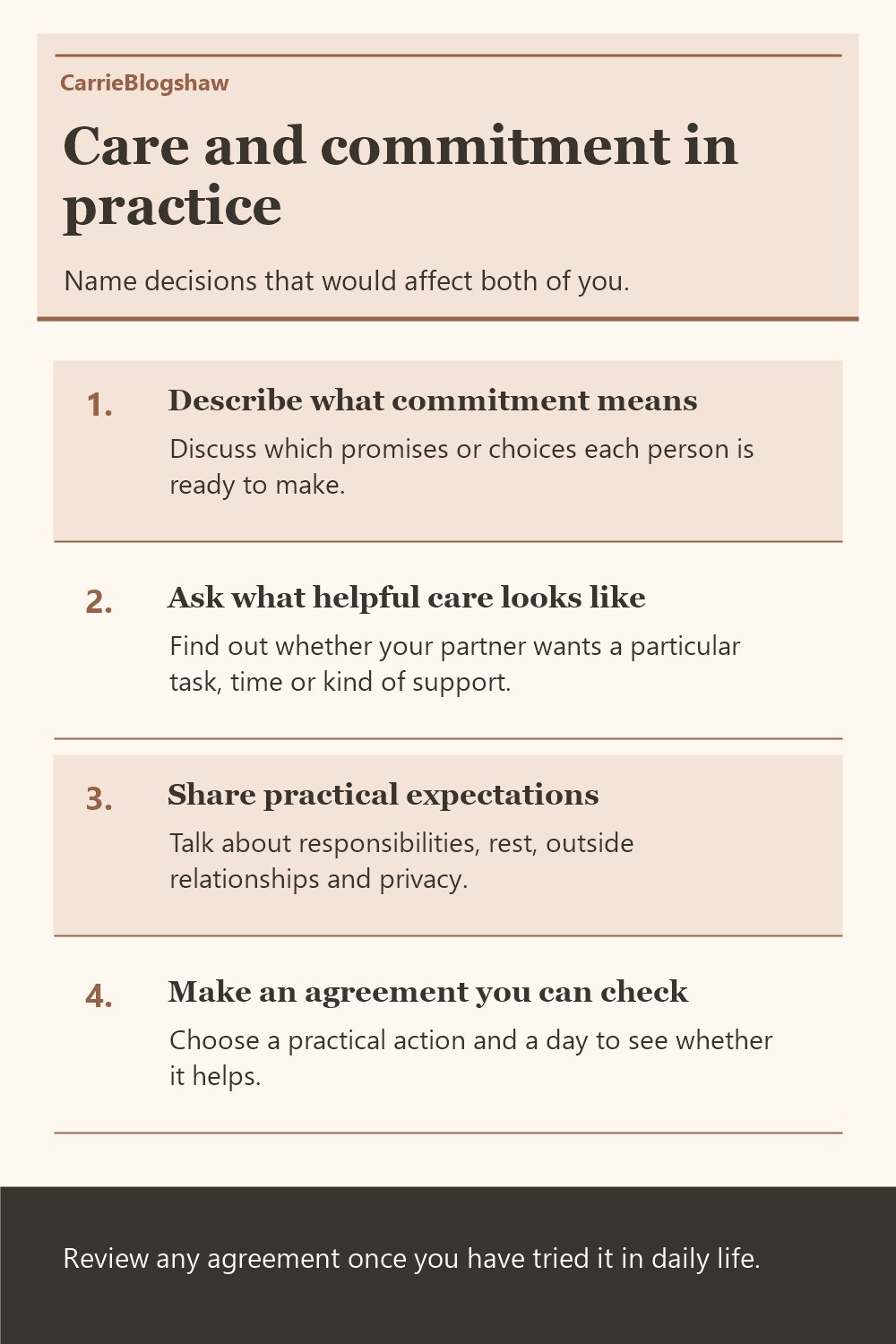
Care and commitment in practice
Name decisions that would affect both of you.
- Describe what commitment means Discuss which promises or choices each person is ready to make.
- Ask what helpful care looks like Find out whether your partner wants a particular task, time or kind of support.
- Share practical expectations Talk about responsibilities, rest, outside relationships and privacy.
- Make an agreement you can check Choose a practical action and a day to see whether it helps.
Review any agreement once you have tried it in daily life.