

Your relationships can differ in timing, length and importance. A useful way to reflect on them is to ask what you want to carry forward, what you need to protect and what choices are available now.
You may have heard a story that divides love into a first romance, a painful second relationship and a lasting third. That story cannot tell you how many relationships you will have or whether a particular one will last. You can make sense of your experience without fitting it into a fixed sequence.
In this article
1. Notice what mattered to you
A first meaningful relationship can happen in youth or adulthood. Rather than deciding what it was supposed to teach you, consider what you actually valued: companionship, shared interests, affection or the experience of being understood.
You can appreciate a good memory without treating that relationship as the standard every future partner must reproduce. Ask which qualities still matter and which preferences have changed as your circumstances have changed.
2. Name hurt without making it a requirement
A difficult relationship does not become necessary or acceptable because somebody calls it a life lesson. You do not have to experience deception, repeated conflict or mistreatment before deserving care.
If you want to reflect on a painful experience, describe what happened and how it affected you. Keep responsibility for another person’s harmful behaviour with them. You can consider a boundary for the future without deciding that you caused the hurt by choosing imperfectly.
Some experiences may remain upsetting or difficult to understand. You can seek trusted or qualified support rather than requiring yourself to find a positive meaning immediately.
3. Carry forward useful learning
Choose one practical question instead of trying to explain your entire relationship history. For example: What did I enjoy? What felt unworkable? What would I want to discuss earlier next time?
Turn an answer into something you can recognise or ask for. “I want us to discuss exclusivity directly” is more useful than “I will never be hurt again.” “I need time for my own friendships” describes a need you can keep in view.
You can also notice choices you were glad to make, including asking a difficult question or leaving an arrangement that did not suit you. Reflection does not have to focus only on mistakes.
4. Consider each new connection on its own
A later relationship is not automatically easier, safer or more genuine because of its place in a sequence. Consider the person and arrangement available now: is interest mutual, are intentions compatible and are boundaries respected?
Try to separate a present concern from a prediction based only on the past. A new partner is not responsible for somebody else’s behaviour. At the same time, you do not have to ignore a current problem to prove you are ready to trust again.
5. Respect your own pace
You might want to date, remain single or take a break from deciding. There is no relationship count you need to reach and no deadline that makes affection meaningful.
If other people describe a new relationship as your guaranteed “forever love,” you can keep your own perspective: “I am enjoying getting to know them, and we are taking our time.” Hope can leave room for learning more.
6. Choose one next step
Pick something relevant to your current life: clarify a preference, arrange support, have an honest conversation or make time for an activity you value. Keep the step small enough to carry out.
You do not need a final explanation for every past relationship before making a thoughtful choice today. You can keep what you have learned and revise your expectations as new information arrives.
Read the infographic in text
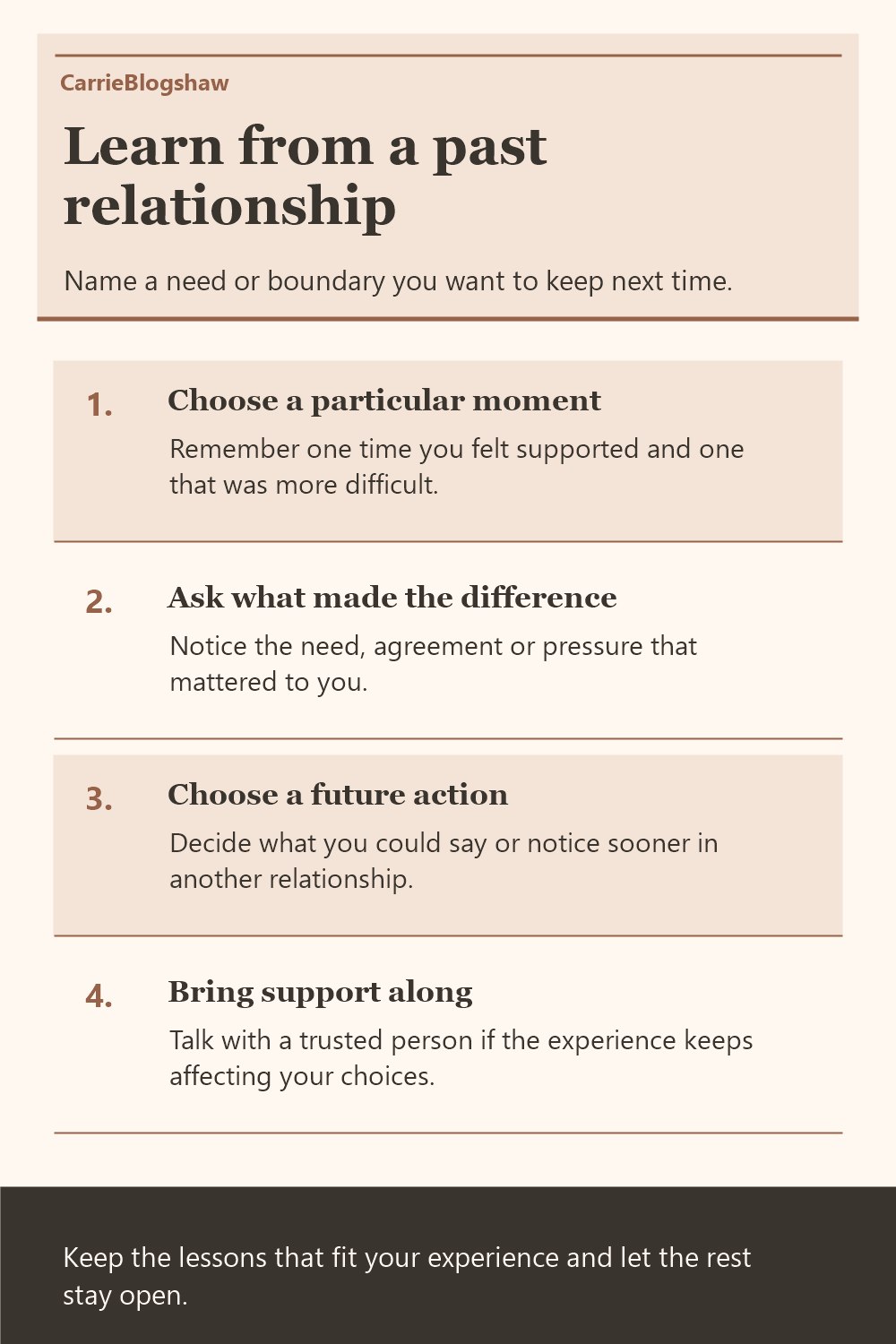
Learn from a past relationship
Name a need or boundary you want to keep next time.
- Choose a particular moment Remember one time you felt supported and one that was more difficult.
- Ask what made the difference Notice the need, agreement or pressure that mattered to you.
- Choose a future action Decide what you could say or notice sooner in another relationship.
- Bring support along Talk with a trusted person if the experience keeps affecting your choices.
Keep the lessons that fit your experience and let the rest stay open.