

A partner’s contact with an ex can raise questions about time, privacy and the relationship you want together. A message, a memento or a difficult feeling cannot by itself tell you whether they have moved on.
Focus on the context, the effect on your relationship and the agreements you can discuss. These nine questions offer practical starting points.
In this guide
- What is the concern you want to discuss?
- What is the online context?
- What do photographs or mementos mean?
- How much emotional support can you offer?
- What conversation or agreement would help?
- Which shared responsibilities need contact?
- How are comparisons affecting you?
- What arrangements fit both of you?
- What will you do if an agreement does not work?
1. What is the concern you want to discuss?
Begin with a specific event or pattern. Perhaps your plans changed after a call, a conversation repeatedly returned to the breakup or you learned about an arrangement that affects you.
Separate the event from the conclusion you fear. “Our evening was interrupted three times” identifies something you can discuss. “You must still love your ex” claims knowledge you do not have. You can take the effect on you seriously without proving the other person’s private feelings.
2. What is the online context?
Following an ex, liking a photograph or keeping an old post does not reveal the whole relationship. Ask about the concern that matters now rather than counting online interactions as a test of commitment.
If you have an agreement about public relationship information, discuss what each person understood. Respect private accounts and messages. Access to a phone or a demand to delete every trace of the past is not a substitute for an agreement both people choose.
3. What do photographs or mementos mean?
A gift or photograph may have personal, family or practical significance. Its presence alone cannot tell you that your partner wants to return to an ex.
You can explain how a display or object affects you and ask about its meaning. “I feel uncomfortable with this photograph beside our bed; can we discuss where it belongs?” is more specific than insisting that keeping any memento is unhealthy. The other person can answer, and you can consider whether the arrangement works for you.
4. How much emotional support can you offer?
Someone may feel anger, grief or frustration about a previous relationship. You can listen while deciding how much of your time together you want to spend discussing it.
Try a clear limit: “I can listen for a while, but I would like the rest of tonight to be about us.” If they want further support, they can consider friends, family or a counsellor. You do not have to become their only listener, and attending therapy should not become a test they must pass to prove love.
5. What conversation or agreement would help?
Choose one request that addresses your concern. You might want notice when shared plans change, clarity about whether you are exclusive or a conversation about time spent together.
Ask whether your partner can agree, and listen to their answer. The NHS guide to healthy relationships suggests checking your understanding, distinguishing facts from assumptions and taking a break when a difficult discussion needs time.
An honest difference in preferences can still mean that the relationship does not suit you. You do not need to turn that difference into an accusation.
6. Which shared responsibilities need contact?
Co-parenting, unresolved practical arrangements, work or shared commitments may involve continuing contact with an ex. Ask which responsibilities affect your plans and what you need to understand about them.
Where children are involved, consider their routines and relationships rather than making every contact a competition. Plunket’s guidance for new relationships encourages gradual introductions, room for children’s feelings and maintaining familiar routines. A new partner does not need to take over a parenting role immediately.
Discuss your own role without expecting children to carry messages or prove which adult matters most.
7. How are comparisons affecting you?
A brief reference to a past experience is different from repeatedly telling you to behave, dress or respond like an ex. Describe the particular comparison and its effect.
You might say, “When you compare how we handle disagreements, I feel that my own view gets lost. I want us to discuss what happened between us.” Notice whether there is room for your experience, without trying to rank yourself against another person.
8. What arrangements fit both of you?
There is no single contact rule that every couple must adopt. Discuss the type of relationship you both want, what information is relevant and what each person is willing to offer.
A workable agreement should be clear enough to understand without requiring constant surveillance. You might arrange protected time together, discuss significant changes in advance or decide that you want different relationship arrangements. You can decline an arrangement that leaves important needs unmet.
9. What will you do if an agreement does not work?
Return to the actual agreement and what happened. Was it unclear, impractical or repeatedly disregarded? Consider whether a different arrangement would help and whether you freely want to continue.
You can slow down, seek outside support or leave. Contact with an ex does not automatically make a relationship wrong, and explaining its context does not require you to stay. Your choices can be based on the relationship you are experiencing now.
If questions or boundaries lead to threats, monitoring or intimidation, seek private support rather than assuming you must confront your partner again. The guide to relationship red flags offers more help distinguishing differences from controlling conduct.
Read the infographic in text
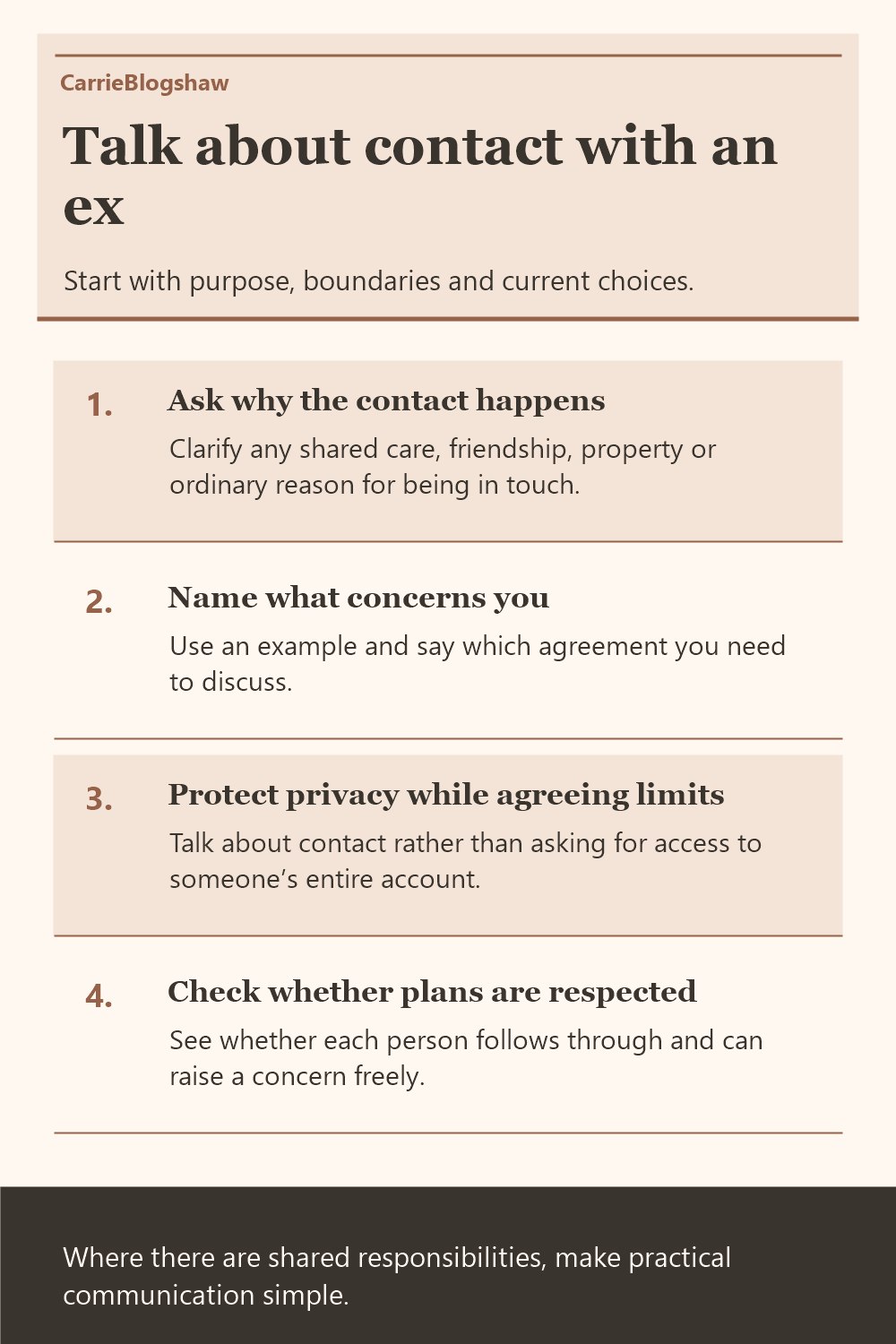
Talk about contact with an ex
Start with purpose, boundaries and current choices.
- Ask why the contact happens Clarify any shared care, friendship, property or ordinary reason for being in touch.
- Name what concerns you Use an example and say which agreement you need to discuss.
- Protect privacy while agreeing limits Talk about contact rather than asking for access to someone’s entire account.
- Check whether plans are respected See whether each person follows through and can raise a concern freely.
Where there are shared responsibilities, make practical communication simple.