

Friendly conversation, flirting and regular messages can feel promising without answering whether someone wants to date you. You may enjoy the connection and still be unsure what it means. You do not have to solve that uncertainty by examining every small gesture.
Interest, availability and wanting a relationship are separate questions. A clear invitation and an honest conversation can give you more useful information than a rule about what all men supposedly do when they like someone.
In this article
1. Separate a possibility from a promise
A smile, a compliment or a quick reply can have several meanings. Someone may be friendly, attracted, uncertain or interested in a different kind of connection. You cannot establish which explanation is true from one signal.
Write down what has actually happened: “We have met twice with friends, and we message most evenings.” Keep that separate from “They must be afraid of how much they like me.” You do not need an explanation for their private feelings before deciding what you want to ask.
Notice your own interest too. The question is not only whether they choose you; it is whether you would like to explore dating this person.
2. Ask whether this is a date
If you want to know whether there is mutual interest, make a clear, manageable invitation. For example: “I enjoy spending time with you. Would you like to get coffee on Saturday as a date?” Choose a plan that leaves both people room to accept or decline.
You can also clarify an existing invitation: “That sounds nice. Are you thinking of it as a date or as friends meeting up?” Being direct does not require a declaration of love or an immediate discussion about the entire future.
If the person has already said no or asked for space, respect that answer. Repeated invitations are not a way to establish how they secretly feel.
3. Listen to the answer and the plan
A clear yes followed by a workable plan tells you they want that date. It does not establish exclusivity or promise a relationship. Those questions can be discussed as you get to know one another.
If the answer is no, accept it without asking them to defend their preference. If it is vague, you might ask one practical follow-up: “Would another day work?” Then leave room for them to respond rather than repeatedly trying to secure an answer.
Someone can be interested and unavailable, or enjoy your company while wanting friendship. You do not need to diagnose the reason. Consider whether the arrangement they are offering suits you.
4. Keep your own life and boundaries in view
Choose how much time and attention you want to give an uncertain connection. Keep plans with friends, attend to responsibilities and make room for activities you enjoy. These parts of life matter even when you hope a relationship will develop.
If you are checking messages repeatedly, consider a practical limit, such as looking at them at chosen times. You are not making yourself less available to create a reaction; you are deciding how you want to spend your day.
It is also reasonable to say, “I am looking for a relationship, so a casual arrangement is not right for me.” You do not have to hide that preference to seem relaxed.
5. Choose whether to step back
If plans repeatedly remain uncertain or your goals differ, you can stop pursuing dating without deciding that the other person is bad or that you were foolish to hope. A mismatch does not measure your worth.
You might choose friendship if that feels comfortable for both of you, or take some distance if it does not. You can act on the information available now while accepting that you may never know every reason behind someone else’s feelings.
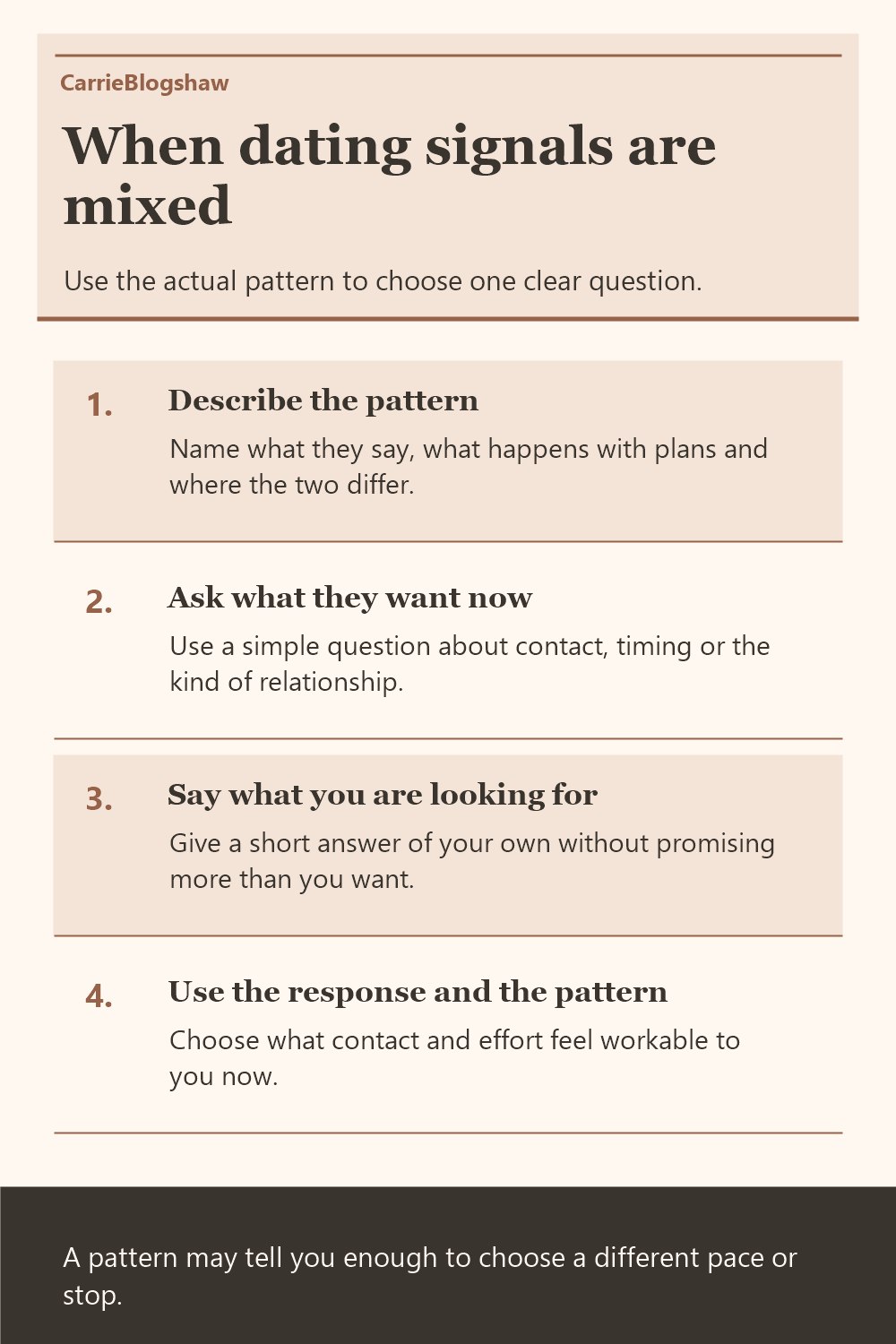
Read the infographic in text
When dating signals are mixed
Use the actual pattern to choose one clear question.
- Describe the pattern Name what they say, what happens with plans and where the two differ.
- Ask what they want now Use a simple question about contact, timing or the kind of relationship.
- Say what you are looking for Give a short answer of your own without promising more than you want.
- Use the response and the pattern Choose what contact and effort feel workable to you now.
A pattern may tell you enough to choose a different pace or stop.