

Self-worth can help you recognise what you need in a relationship and take your own preferences seriously. You can ask for care, protect your privacy and decide whether an arrangement suits you, even on days when you feel unsure of yourself.
A list of desirable qualities is most useful when it connects to everyday behaviour. Consider what respect, honesty and companionship would look like for you, while leaving the other person room to have needs and choices of their own.
In this article
1. Start with everyday respect
Look for room to express a preference, refuse an invitation and raise a concern. Respect includes hearing an answer without insults, pressure or punishment. These expectations apply to both people.
Kindness in ordinary moments
Consider how you treat each other when a plan changes or somebody has an inconvenient need. Affectionate words can matter alongside practical care and consideration.
Consideration you can describe
Turn a general wish into a clear request: “Please tell me if you will be late,” or “I need some notice before making plans.” Explain what helps you, then listen to what is manageable for the other person.
2. Discuss honesty and privacy
Honesty includes being clear about relevant intentions and agreements. It does not require unlimited access to private messages, passwords or every part of someone’s history. Discuss information that affects a shared decision without treating surveillance as proof of love.
Openness at a chosen pace
You can share feelings gradually and decide what you are comfortable discussing. Nobody owes a partner every difficult memory or personal detail. Respect a boundary about disclosure, including your own.
Understanding through questions
Ask what a preference means instead of expecting either person to read the other’s mind. “Would you like company or some time alone?” can be more useful than assuming you already know.
3. Make room for attention and enjoyment
Talk about the amount and kind of contact you enjoy. Some people value a daily conversation; others prefer a different rhythm. Consider whether there is an arrangement that works without requiring constant availability.
Humour that feels good to both of you
Shared laughter can be enjoyable, and you can say when a joke hurts. You do not have to accept humiliation to show that you have a sense of humour.
Attraction and affection on your terms
You can value physical attraction and choose the affection you want. A partner’s wishes do not remove your right to say no, change your mind or prefer a different pace.
4. Consider disagreement and repair
A useful conversation includes time to explain a concern and hear a response. The NHS guidance on maintaining healthy relationships recommends checking that you understand the other person and taking a pause if a discussion becomes too heated.
Calm without silencing a concern
You can ask to return to a discussion at a calmer time. Agree on a practical next opportunity where possible, rather than requiring somebody to pretend an unresolved issue has disappeared.
Compromise with limits
Some differences allow a shared solution, such as alternating activities. Others may involve an essential need or incompatible goal. You do not have to compromise consent, safety or a major life decision to prove that you are cooperative.
5. Keep your worth separate from approval
Someone’s attraction, readiness or decision to date you does not determine your value. A disappointing answer can tell you about the relationship available without becoming a judgement on your entire life.
Respect while confidence varies
You deserve respectful treatment while learning to name your needs, including if you have stayed in an arrangement that hurt. Responsibility for another person’s harmful behaviour remains with them.
6. Choose how to take part
Consider the relationship as it is now. Can you discuss ordinary needs? Are your choices respected? Is there a workable response when a problem is raised? You may decide to keep learning together, ask for a specific change or step back.
If you feel controlled or unsafe, trusted support can help you consider safer options. You can protect yourself without completing another conversation first.
You do not need a perfect partner or permanent confidence to make a thoughtful choice. Begin with one need you want to recognise and one action that is yours to take.
Read the infographic in text
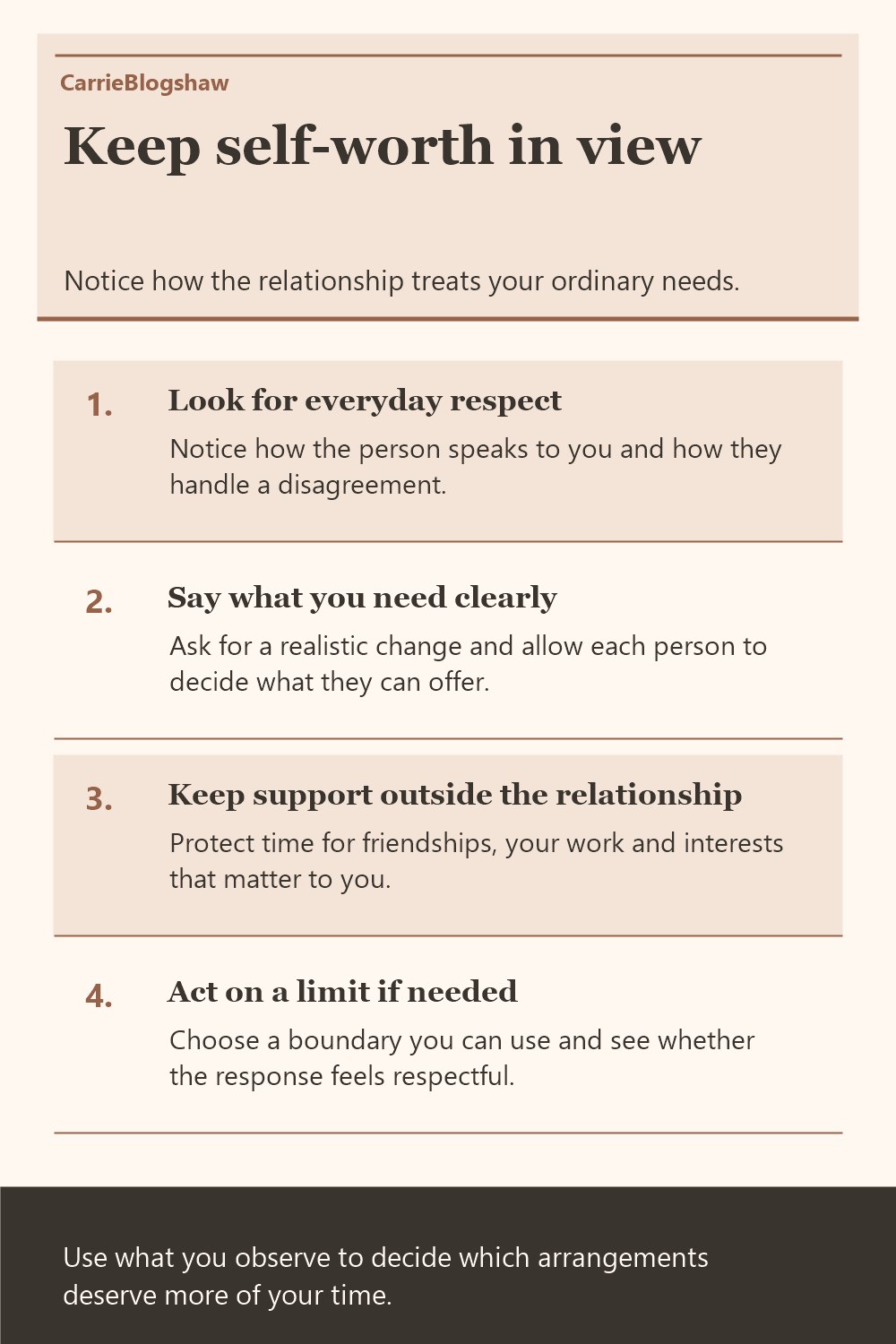
Keep self-worth in view
Notice how the relationship treats your ordinary needs.
- Look for everyday respect Notice how the person speaks to you and how they handle a disagreement.
- Say what you need clearly Ask for a realistic change and allow each person to decide what they can offer.
- Keep support outside the relationship Protect time for friendships, your work and interests that matter to you.
- Act on a limit if needed Choose a boundary you can use and see whether the response feels respectful.
Use what you observe to decide which arrangements deserve more of your time.