

A relationship can be an important part of your life alongside friendships, interests, work, rest and personal goals. Keeping space for those things gives you room to participate as yourself and make choices about how you spend your time.
There is no single amount of time that every couple should spend together or apart. Discuss what each of you wants, the responsibilities you share and an arrangement that can work in practice.
In this article
1. Make room for your own time
Choose something you enjoy or need independently: reading, a hobby, a walk or an uninterrupted rest. You can have shared interests and separate ones without requiring either person to enjoy the same activities.
Time alone in a shared home
If you live together, discuss a practical signal or period for quiet time. Consider the space available and any caring responsibilities, so a request for a break does not leave necessary tasks unaddressed.
A quiet activity you choose
You might enjoy meditation, music or sitting quietly. Choose what suits you rather than treating one activity as a requirement. You can also prefer company while doing different things.
2. Discuss plans and contact
Tell each other about plans that affect a shared arrangement. You might agree when to confirm a meal, who is collecting a child or how much notice helps with changing a plan. Coordination can support both people’s independence.
A manageable rhythm for messages
Discuss availability instead of assuming that a slow reply means disinterest. You can put a phone away during work or an activity and explain when you expect to be available. Constant contact does not need to become a measure of affection.
3. Keep connections beyond the relationship
Consider the people and groups you want in your life. A partner does not have to meet every need for companionship, conversation or shared interests. Make room for relationships that are meaningful and respectful to you.
Friendships that are your own
You can spend time with existing friends or meet people through an activity you enjoy. Some friendships may become shared, while others remain independent. Listen to each other without requiring access to every private conversation.
Family contact by choice
Choose the family contact that fits your circumstances and boundaries. Holidays and celebrations may need planning, but you do not have to maintain an unsafe or unwanted connection because it is called a family obligation.
Room for your partner’s friendships
Offer the same respect for their independent connections. You can discuss an actual concern without assuming you should choose their friends or supervise every meeting.
4. Protect responsibilities and personal goals
Discuss work, study, care and other commitments that need time. Avoid making an important change only because you feel pressured to prove devotion. Consider what the change would mean for your own needs and shared responsibilities.
A goal that belongs to you
Choose one manageable aim, such as finishing a course task or returning to an interest. You can ask for practical cooperation without requiring your partner to share the same goal.
5. Talk about needs and boundaries
Describe what you want clearly: “I would like Wednesday evening for my class,” or “I need an hour to myself after work.” Hear the other person’s needs and discuss any practical conflict.
Respectful treatment
Time apart should leave room for consent and ordinary consideration. You can ask for space without using silence to frighten or punish the other person.
Check in without monitoring
Ask how an arrangement is working for both of you. A check-in can be a conversation about needs; it does not require passwords, constant location sharing or repeated proof of where somebody has been.
When a boundary is pressured
If a request for normal independence leads to threats, intimidation or isolation, consider trusted or specialist support. You do not have to keep negotiating in a conversation that feels unsafe.
6. Review what works for both people
Try one specific arrangement and revisit it when schedules or needs change. You may want more time together, more time separately or clearer coordination.
Keep the discussion connected to your actual lives. You can care about the relationship while maintaining the interests, choices and connections that matter to you.
Read the infographic in text
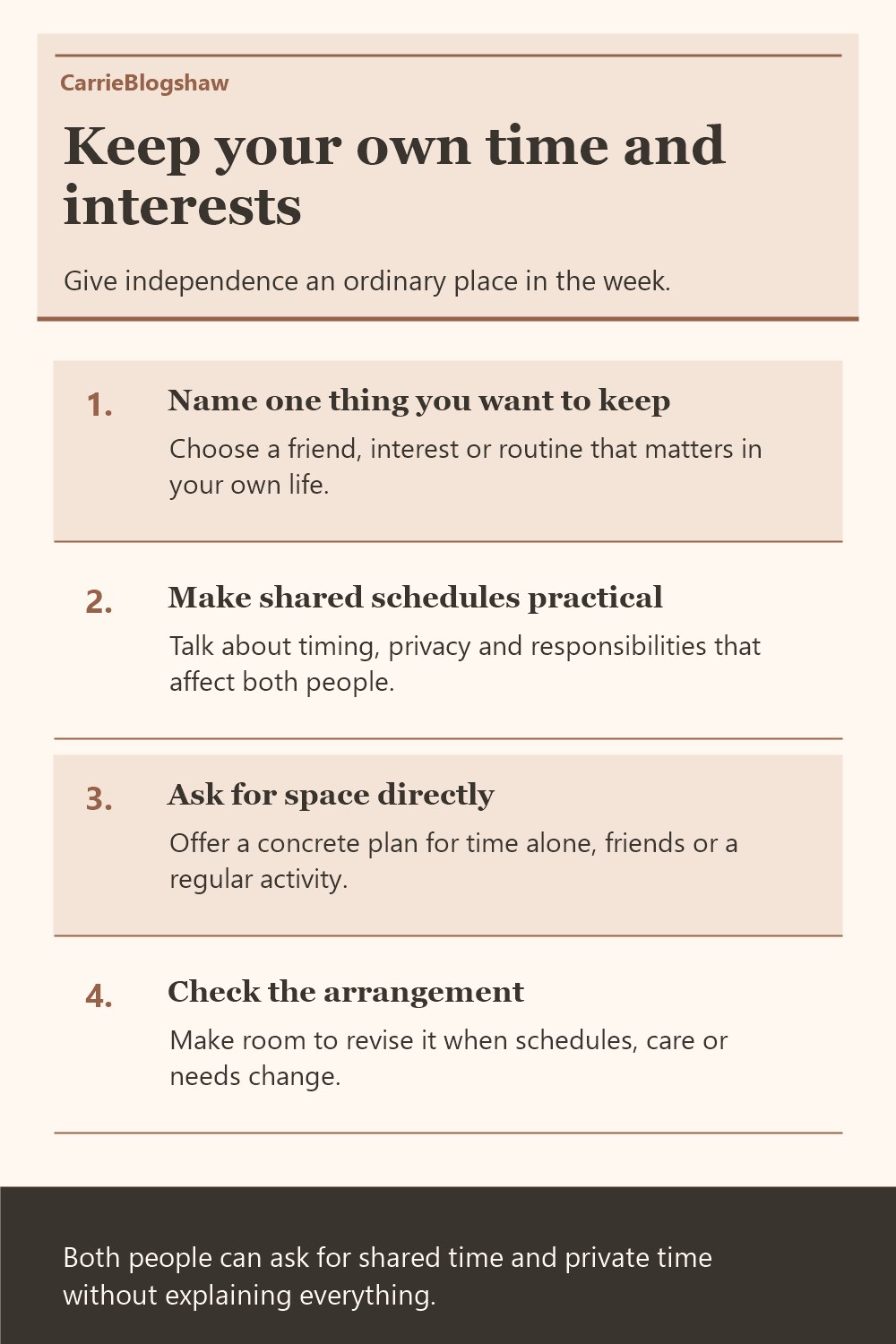
Keep your own time and interests
Give independence an ordinary place in the week.
- Name one thing you want to keep Choose a friend, interest or routine that matters in your own life.
- Make shared schedules practical Talk about timing, privacy and responsibilities that affect both people.
- Ask for space directly Offer a concrete plan for time alone, friends or a regular activity.
- Check the arrangement Make room to revise it when schedules, care or needs change.
Both people can ask for shared time and private time without explaining everything.