

Being single can reflect preference, circumstances, timing or the absence of a relationship you want to take part in. You might enjoy it, feel disappointed or move between those feelings. Your relationship status does not explain your character or determine your worth.
If you want to reflect on dating, begin with a question that belongs to you: Do I want to meet someone now? What kind of connection would I welcome? What would make the next step manageable?
In this article
1. Leave room for your own choice
You do not need to identify a personal flaw to explain why you are single. You may prefer your current life, have limited time, be recovering from a breakup or want a relationship that has not become available. You can also be unsure.
Other people may assume that you are afraid, too independent or unwilling to try. You can keep your answer brief: “I am making choices that fit my life,” or “I would like a relationship, but I do not want to discuss it today.”
2. Consider attraction and compatibility separately
You may feel attracted to someone who wants a different arrangement. You may also enjoy someone’s company without wanting to date them. Neither feeling requires you to continue a romantic connection.
If you want to date, consider whether interest is mutual and intentions are compatible. A conversation about what each person wants gives you more useful information than deciding that attraction must lead to commitment.
3. Choose a pace for closeness
You can take time before meeting, sharing personal information or becoming physically affectionate. A boundary about closeness does not by itself show that you are incapable of a relationship.
If an experience has made dating difficult, you can seek support and choose a smaller step when you want one. You do not have to remove a protective boundary or accept an unwanted invitation to prove that you have moved on.
Make uncertainty manageable
A short first meeting, a clear end time or a break from an app may suit you better than an open-ended plan. You can acknowledge uncertainty while keeping your choices practical and within your own limits.
4. Clarify needs and preferences
Distinguish an essential need from something you might be flexible about. Respect for your refusal may be essential; a shared hobby may be a preference. Wanting the same kind of commitment may need a direct discussion.
You can review a preference without judging yourself for having it. You can also keep a boundary that matters, even if it means declining a connection. More dates are not automatically a better outcome than a choice that fits you.
5. Keep worth separate from relationship status
A declined invitation or an unsuccessful date can hurt. It does not establish that nobody will want you, or that you must become a different person before deserving care.
Try describing the event as specifically as possible: “That person did not want another date.” Leave room for what you do not know rather than turning one answer into a prediction about every future relationship.
6. Choose the connection you want now
If you want more company, consider a friend, a community activity, a relative you trust or a dating opportunity that interests you. Romantic partnership is one possible source of connection, and you can build other relationships whether or not you date.
Review one practical habit
If you want to change something, choose a habit you can influence: suggest a meeting, try an activity or set a limit on app time. Review whether it helped instead of treating it as a test you must pass.
You can choose to date, pause or stay single. The next step can reflect what you want now and remain open to change as your circumstances develop.
Read the infographic in text
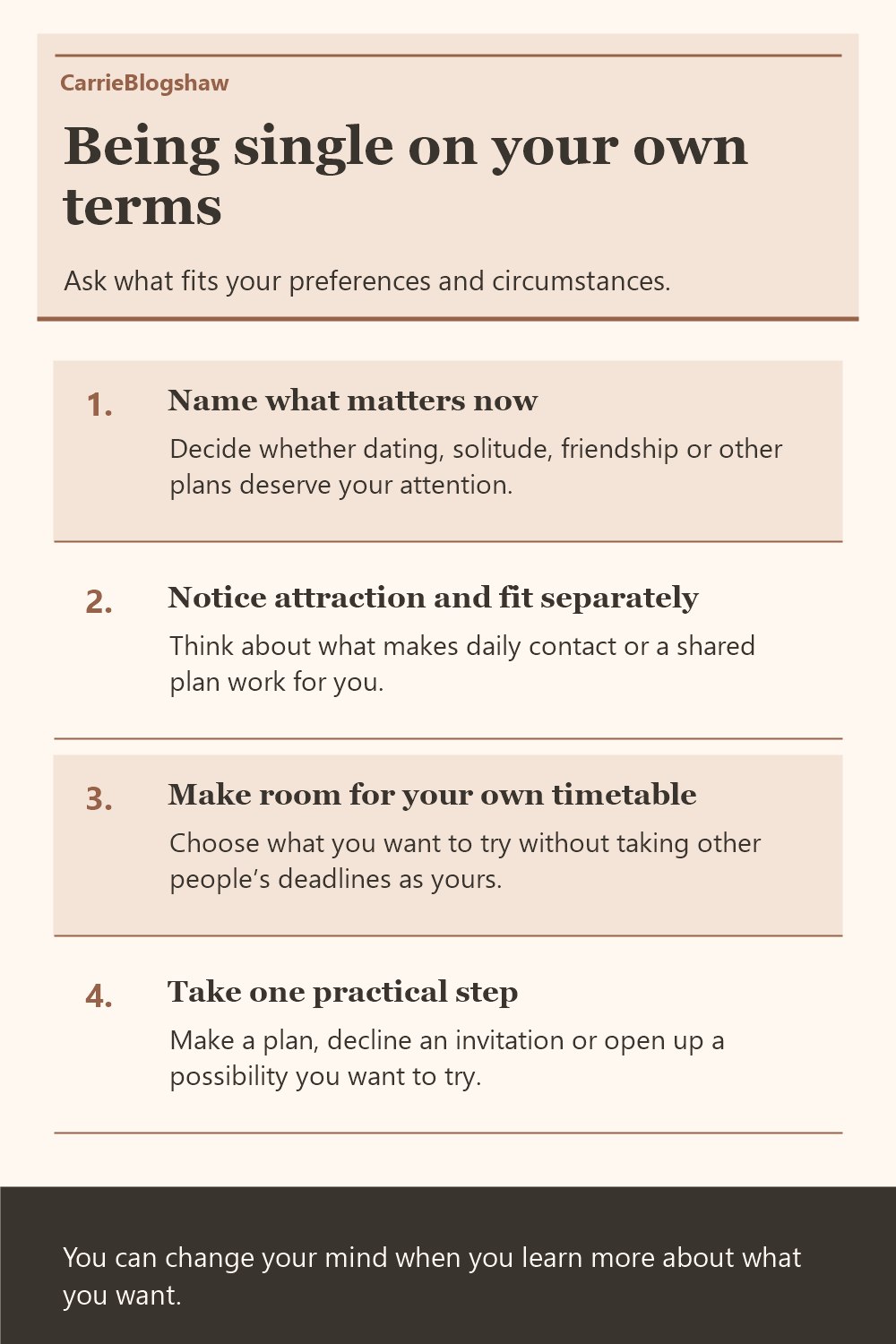
Being single on your own terms
Ask what fits your preferences and circumstances.
- Name what matters now Decide whether dating, solitude, friendship or other plans deserve your attention.
- Notice attraction and fit separately Think about what makes daily contact or a shared plan work for you.
- Make room for your own timetable Choose what you want to try without taking other people’s deadlines as yours.
- Take one practical step Make a plan, decline an invitation or open up a possibility you want to try.
You can change your mind when you learn more about what you want.