

Wanting someone to love you can make every conversation feel important. You may be looking for the right message, appearance or moment to turn your interest into a relationship. You can create opportunities to get to know each other, but you cannot choose the other person’s feelings.
A more useful question is whether you can express what you want, hear an honest answer and decide what works for you. You do not have to become a different person or keep pursuing someone to prove your worth.
In this article
1. Leave room for either answer
Hope can sit alongside uncertainty. A friendly conversation, a compliment or a good date does not establish a promise of love. Let the connection develop through what you both say and choose, rather than treating small gestures as a hidden answer.
Before you approach them, consider what you want to offer and what you are prepared to hear. You can feel disappointed by a refusal without treating it as evidence that you are unlovable. Their decision concerns this connection; it does not settle your value.

2. Express interest honestly and without pressure
If the circumstances are appropriate, make an invitation that leaves a clear choice. For example: “I enjoy talking with you. Would you like to go on a date?” Choose a setting in which they can answer freely, rather than asking in front of an audience or turning the invitation into a test.
You do not need an elaborate performance, a jealousy tactic or a friend to campaign for you. Share your interests and preferences at a pace that feels comfortable. Being honest also means allowing differences to become visible.
3. Choose comfort over an appearance test
Wear something that suits the occasion and lets you feel comfortable. Preparing for a date can be enjoyable, but a particular body, outfit or level of confidence is not a requirement for being treated with respect.
Notice whether you can relax enough to make your own choices around this person. Are you agreeing to plans you dislike, hiding important preferences or spending more than you want to impress them? Consider a simpler plan that gives you room to be present.
4. Listen and check what is mutual
Give each other room to speak and ask about anything you do not understand. The NHS guide to healthy relationships encourages open conversation and listening that checks your understanding.
Look at what has actually been agreed. Do you both want to date, and are the plans workable for you? Frequent messages alone cannot answer every question about commitment. You can ask what they are looking for without asking them to promise a future they have not chosen.
5. Respect a no and decide what uncertainty means for you
If they decline, stop trying to persuade them. Do not repeatedly ask, contact them through other accounts or interpret a refusal as a challenge to become more persistent. Friendship is also a choice for both people, rather than a waiting room for an eventual romance.
An unclear answer can leave you uncertain. You can ask for clarification once where appropriate, and you can decide not to keep waiting. You do not need proof of bad intentions to step back from a situation that does not suit you.
6. Care for yourself afterward
Make space for the feelings that follow, whether they include excitement, sadness or relief. Talk with someone you trust if you want support, and consider a pause from checking messages or social profiles if that helps you settle.
Keep the parts of life that matter to you in view. A possible relationship can be important without becoming the measure of your whole future. Your next step might be another date, a clear boundary or time away from dating.
Read the infographic in text
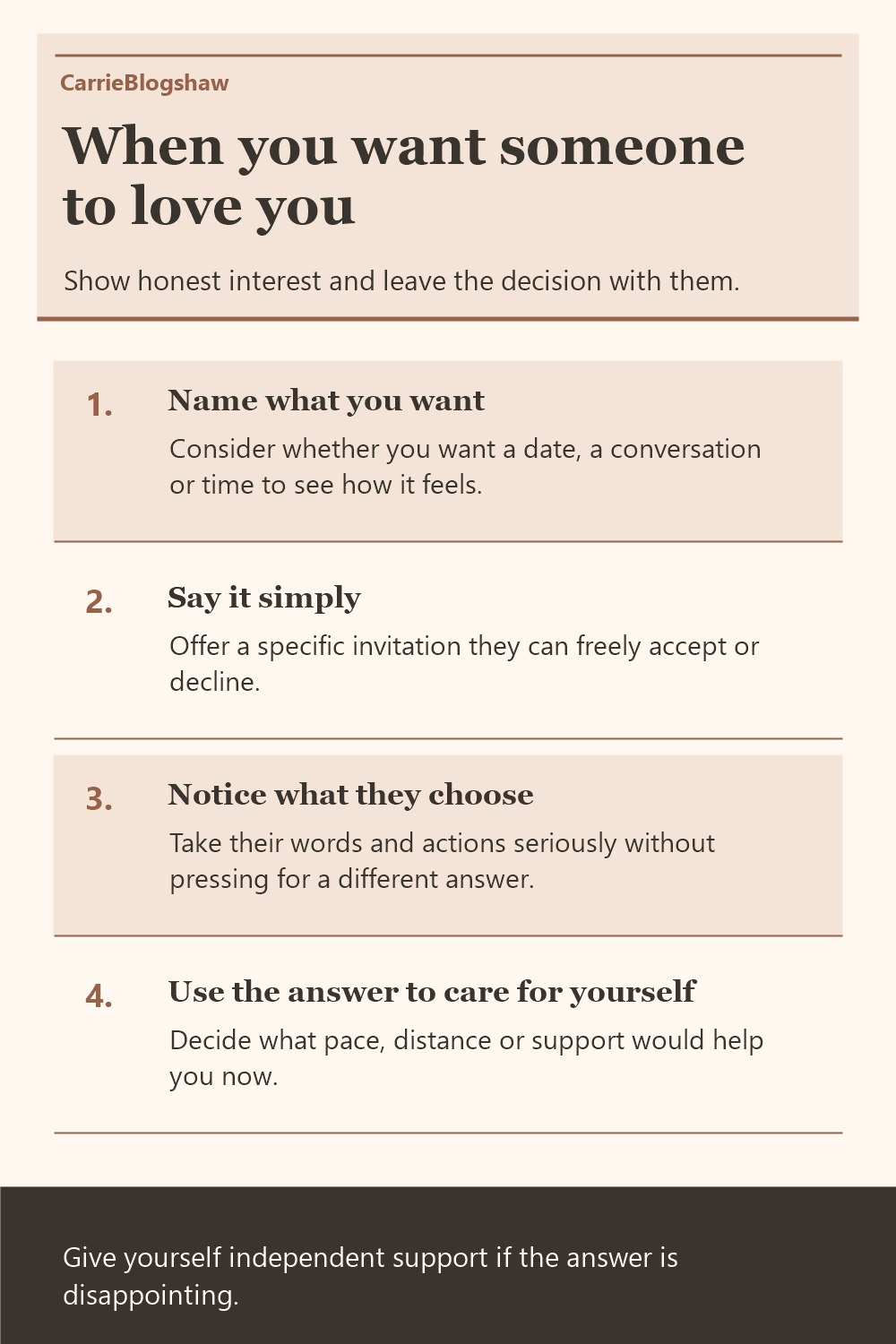
When you want someone to love you
Show honest interest and leave the decision with them.
- Name what you want Consider whether you want a date, a conversation or time to see how it feels.
- Say it simply Offer a specific invitation they can freely accept or decline.
- Notice what they choose Take their words and actions seriously without pressing for a different answer.
- Use the answer to care for yourself Decide what pace, distance or support would help you now.
Give yourself independent support if the answer is disappointing.