

A goal can matter to you even when you feel unsure, tired or far from ready. Self-awareness helps you notice what you want, what is getting in the way and which kind of support would make a difference. You do not have to achieve perfect confidence before taking a useful step.
Start with a goal that belongs to you. Then make a plan small enough to try in the life you actually have, including your responsibilities, resources and need for rest.
In this article
1. Name what matters to you
Describe the goal in ordinary language. “I want work that leaves time for my family” gives you something different to explore from “I should be more successful.” Ask whose expectations you are trying to meet and what you hope would change in an average week.
You might value learning, stability, creativity, companionship or more independence. More than one value can matter. If two priorities compete, naming the trade-off helps you choose consciously instead of treating every opportunity as something you must accept.
2. Separate your worth from the outcome
Getting a job, finishing a course or finding a partner does not establish your value as a person. Losing an opportunity does not take that value away. You can care about an outcome without making it a test you must pass to deserve respect.
Try a realistic statement you can use when progress is slow: “This matters to me, and I am still learning what is possible.” You do not need to force enthusiasm or pretend that disappointment feels good.
3. Notice barriers and the support they need
Write down what is making the next step difficult. A lack of information may need a conversation; a lack of money may require a cheaper route or a pause. Health, caring responsibilities, discrimination and limited local opportunities can affect what is available.
These barriers are not evidence that you have failed to love yourself enough. Identify any practical help you could request, such as feedback on an application, accessible course information or an agreed hour of childcare. Be specific about what would help.
4. Choose a workable experiment
Instead of deciding the whole future, choose one action that will give you information. You could ask a training provider about entry requirements, attend an introductory session or draft the first paragraph of an application.
The NHS problem-solving guide suggests distinguishing practical problems from worries you cannot act on, considering possible solutions and making a specific plan. Use that approach to choose something you can actually try rather than planning around a perfect result.
5. Make room in your week
Decide when the action could fit, how long it needs and what has to happen first. A short, scheduled conversation can be more useful than an ambitious list with no time attached. Keep the first version manageable.
Notice what you are already carrying. You may need to postpone another task, ask someone to share work or choose a slower pace. Protect time for sleep, ordinary care and relationships; these are part of your life while you pursue the goal.
6. Review the plan without turning it into self-blame
After trying the step, ask what you learned. Did you gain useful information? Was the action too large? Did an outside constraint change? Decide whether to continue, reduce the task, seek help or choose another route.
Changing a goal can reflect clearer priorities. You are allowed to discover that something no longer suits you, or that now is not the right time. A useful plan leaves room for that decision.
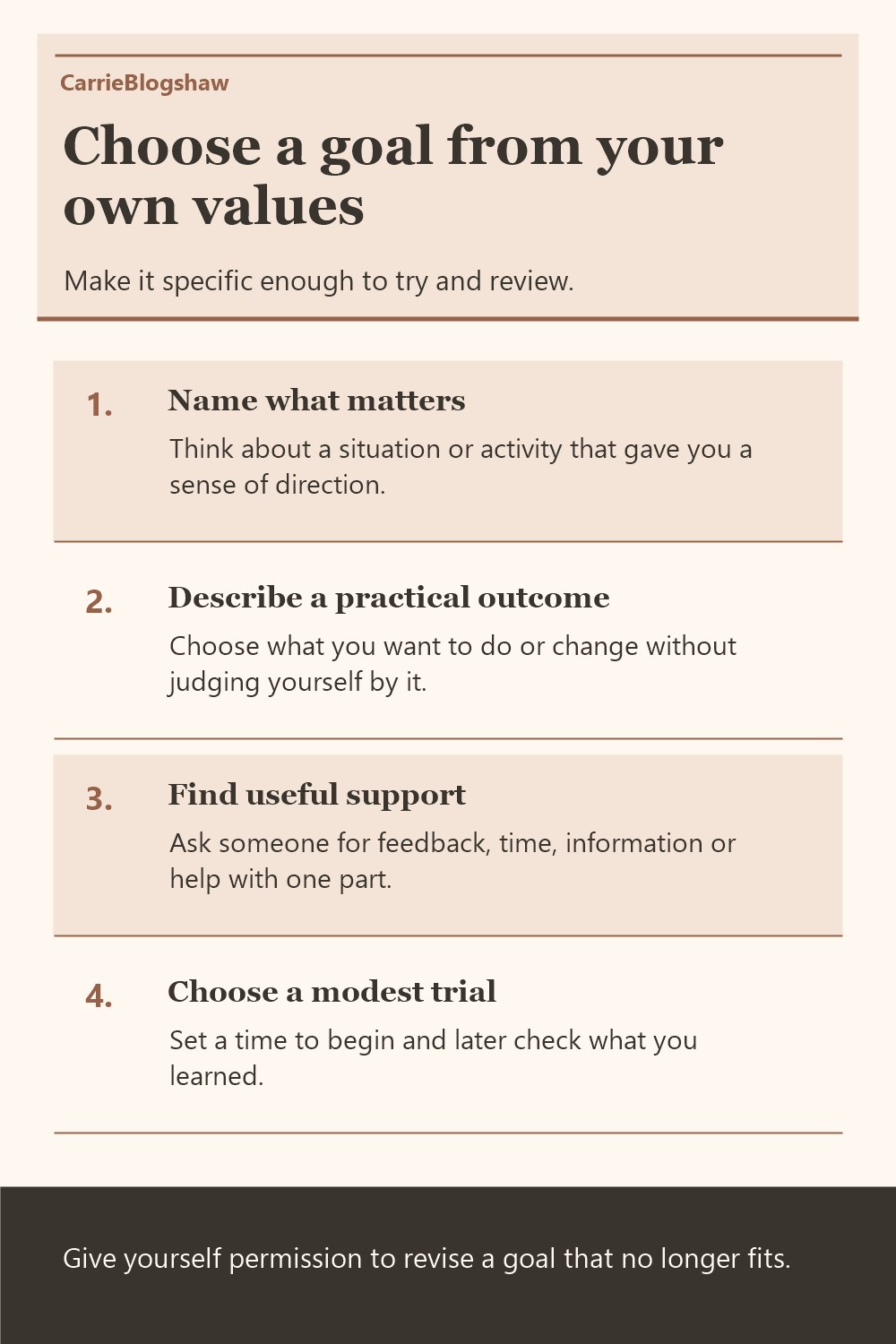
Read the infographic in text
Choose a goal from your own values
Make it specific enough to try and review.
- Name what matters Think about a situation or activity that gave you a sense of direction.
- Describe a practical outcome Choose what you want to do or change without judging yourself by it.
- Find useful support Ask someone for feedback, time, information or help with one part.
- Choose a modest trial Set a time to begin and later check what you learned.
Give yourself permission to revise a goal that no longer fits.