

Discovering yourself can begin with an ordinary question: what feels important to you now? You may be reconsidering a role, adjusting after a change or noticing that familiar choices no longer fit.
You do not need to uncover one permanent identity or a single life purpose. A clearer sense of yourself can develop through reflection, experience and conversations that leave you free to make your own choices.
On this page
Notice what fits your life now
Start with recent experiences instead of a demand to explain your whole personality. When did you feel interested, comfortable, connected or able to speak honestly? Which situations left you performing a role you no longer wanted?
A short note after an activity may reveal more than a long questionnaire completed under pressure. Record what you did, what you liked or disliked and any conditions that mattered. A noisy room, an exhausting week or an unwelcoming group can shape an experience; they do not necessarily tell you whether the activity itself suits you.
You can also notice what you miss. An interest does not have to become a career, a talent or something you share publicly to deserve a place in your life.
Put values into everyday words
Values are easier to work with when you connect them to choices. “Friendship matters to me” might mean making time for a conversation. “I value learning” might mean asking questions or returning to a hobby.
Choose a few values that feel relevant, then ask:
- What would this look like in a small decision this week?
- Am I choosing it freely, or mainly trying to avoid someone’s disapproval?
- What other need or responsibility must I consider?
Values can conflict. You may value both stability and exploration, or generosity and rest. Considering the trade-off is part of making a choice, not evidence that you do not know yourself.
Make room for needs, preferences and limits
Ask what helps you function and what you prefer when you have a choice. Time alone, company, accessibility, predictable arrangements or help with responsibilities may all matter. You do not have to justify every need by turning it into a personality label.
Separate a limit from a judgment about your potential. You might lack time or money for a course now and still be interested in the subject. You may dislike a setting without needing to become more outgoing.
Our article on validating your own experience offers related reflection. Knowing yourself does not make you responsible for another person’s mistreatment.
Try something small enough to learn from
Pick an experiment that fits your circumstances: borrow a book, try an introductory activity, set aside a little time for a neglected interest or ask someone about a role that intrigues you.
Decide how much time or money you can reasonably spend and what would make you stop. Afterward, ask what held your interest, what felt difficult and whether you want to try again under different conditions.
The result need not be a revelation. Discovering that something is not for you is useful too. You do not have to take a major risk to make the exercise count.
Use other perspectives without handing over authority
A trusted person may notice strengths or patterns you overlook. Ask for examples, consider their perspective and decide what fits your experience. Their interpretation is information, not the final definition of who you are.
If prayer, spiritual reflection or another personal practice helps you explore meaning, you can include it. You do not need a reading, a particular object or someone else’s certainty about your destiny to understand your preferences and make decisions.
When reflection brings up distress, confusion or experiences that feel difficult to manage, a qualified professional can offer support. You are allowed to ask for help without already having a clear explanation.
Let your understanding change
Revisit your notes after a while. Look for choices you want to repeat, needs you have been overlooking and assumptions that deserve another look. Our article on self-awareness and personal goals can help you continue the conversation.
A useful outcome may be modest: a clearer request, a renewed interest or permission to change direction. You can build a life that fits you better without having a complete answer to “Who am I?”
Read the infographic in text
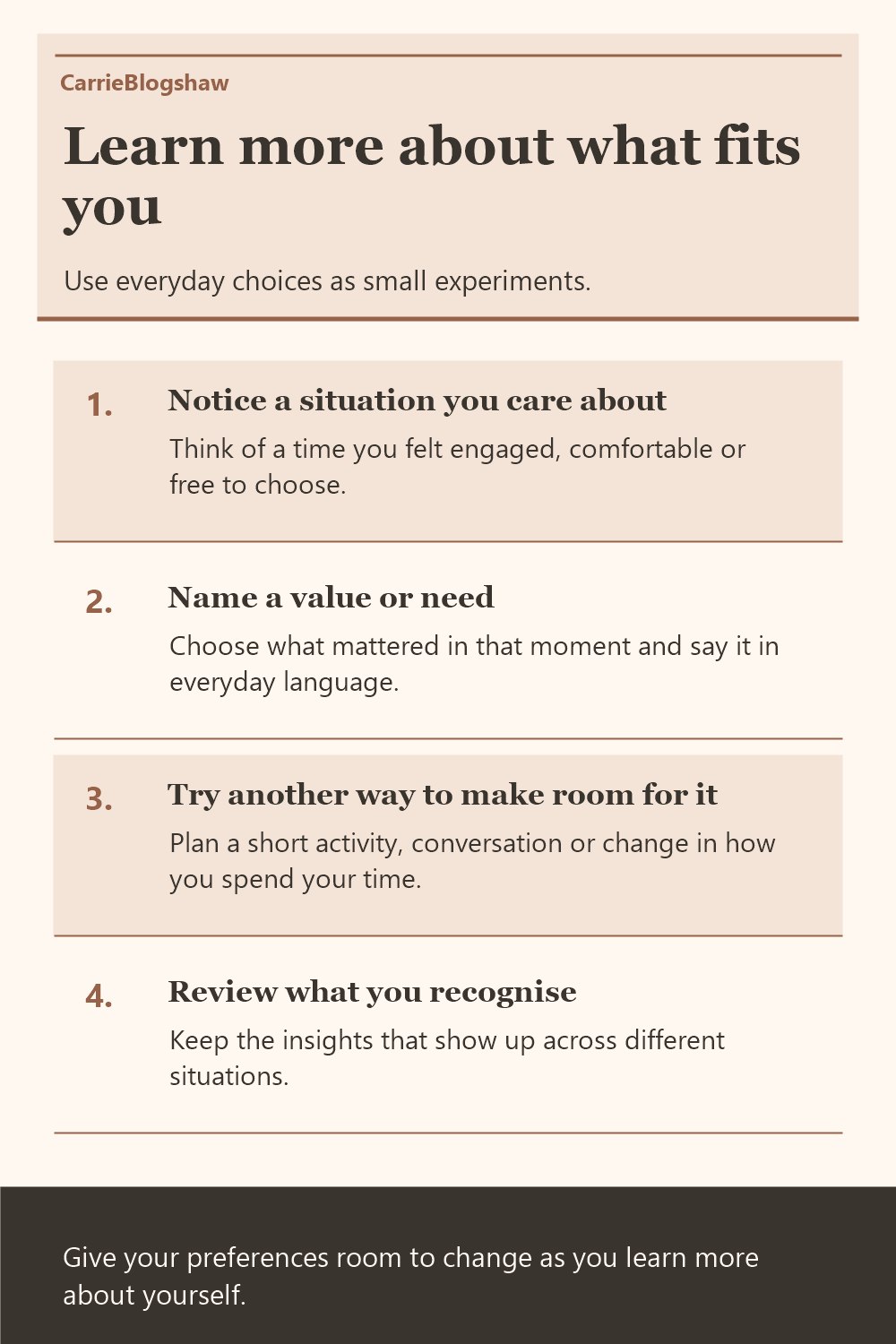
Learn more about what fits you
Use everyday choices as small experiments.
- Notice a situation you care about Think of a time you felt engaged, comfortable or free to choose.
- Name a value or need Choose what mattered in that moment and say it in everyday language.
- Try another way to make room for it Plan a short activity, conversation or change in how you spend your time.
- Review what you recognise Keep the insights that show up across different situations.
Give your preferences room to change as you learn more about yourself.