

Relationship red flags are reasons to look more closely at behaviour, its effect on you and your freedom to choose. They are not a way to read someone’s mind or predict every future action.
Some concerns involve different expectations; others involve disrespect, control or danger. These eight points can help you consider the difference and choose a useful next step.
In this guide
- Start with the conduct and its context
- Take intimidation and coercion seriously
- Notice how your boundaries are handled
- Look closely at humiliation and dismissal
- Keep room for privacy and other relationships
- Look for repair beyond an apology
- Discuss expectations and shared responsibilities
- Choose support that fits the concern
1. Start with the conduct and its context
Describe the specific concern: a request ignored, a plan changed without discussion or a remark that left you embarrassed. Consider how it affected you and whether it has happened before.
Wanting different amounts of time together or disagreeing about a weekend plan may call for a discussion about compatibility. Threats, coercion or physical harm call for attention to safety. You do not have to collect several warning signs before seeking help.
2. Take intimidation and coercion seriously
Pay attention when someone frightens you, restricts your choices, pressures you into sex, controls essential resources or tries to isolate you. These concerns are different from simply having an imperfect partner.
Love is respect describes warning signs of abuse, including monitoring accounts without permission, humiliation, isolation and physical harm. A first incident matters even when you have not yet recognised a longer pattern.
Responsibility belongs to the person choosing harmful behaviour. Your relationship history, tone or difficulty setting a boundary does not make you responsible for their abuse.
3. Notice how your boundaries are handled
Consider what happens when you say no, ask for space or choose a different activity. Can your answer stand, or do you face repeated pressure, ridicule or punishment?
You can change your mind about touch or sex, and you do not need to justify a refusal through a painful personal story. A partner may feel disappointed about an ordinary preference while still respecting your decision.
Discussing a boundary can be useful when safe. You are not required to keep explaining the same refusal until someone agrees that it is reasonable.
4. Look closely at humiliation and dismissal
A joke that continues after you ask for it to stop deserves attention. So does repeatedly dismissing your concerns, denying events or using insults when you disagree.
One difference in recollection does not establish gaslighting. The Western Australian Government’s gaslighting guide explains deliberate manipulation that undermines a person’s trust in their perceptions and memories. You can seek support for what is happening without first winning an argument about the label.
How someone treats a server, colleague or stranger may also matter to you. Consider the behaviour you see now rather than assuming it proves exactly how they will behave in the future.
5. Keep room for privacy and other relationships
Keeping a phone private is not proof of cheating. You can discuss a concern about a broken agreement without demanding passwords, reading private messages or accounting for every hour of another person’s day.
Likewise, a partner declining one family event is different from trying to prevent you from seeing your family. Ask about practical circumstances when you feel able to do so. Notice whether both people remain free to maintain friendships, interests and time alone.
Information about an ex also needs context. Someone describing past abuse is not automatically avoiding responsibility or predicting how they will treat you.
6. Look for repair beyond an apology
If someone hurts you, consider whether they acknowledge the particular action, listen to its effect and follow through on an agreed change. An apology does not require you to forgive immediately or continue the relationship.
For example, an agreement to check before making plans involving you gives you something concrete to review. “I am sorry you are sensitive” does not address the unwanted remark itself. Notice whether the same problem keeps returning while responsibility is repeatedly shifted to you.
7. Discuss expectations and shared responsibilities
Attention, chores, contact and spending can become sources of conflict when expectations differ or remain unspoken. Where it is safe, explain one issue and ask what arrangement each person is willing to make.
A disagreement about a shared bill is different from blocking access to money or basic needs. Similarly, being tired, unhappy or needing mental health support does not by itself establish abuse. The question is how each person behaves and whether your choices and needs are respected.
You may decide that a relationship does not suit you without proving that your partner is a bad person.
8. Choose support that fits the concern
For an ordinary disagreement, you might choose a conversation, a clearer agreement or time to consider compatibility. If you feel afraid, controlled or at risk, begin with private support from a trusted person or domestic abuse advocate.
The National Domestic Violence Hotline offers a personal safety-planning resource for people experiencing abuse, considering leaving or living after separation. Consider using a device you trust if yours may be monitored. You do not have to confront the person or leave immediately to deserve support.
If there is immediate danger, contact local emergency services. You can take the next step that fits your circumstances without waiting for an article to certify the whole relationship.
Read the infographic in text
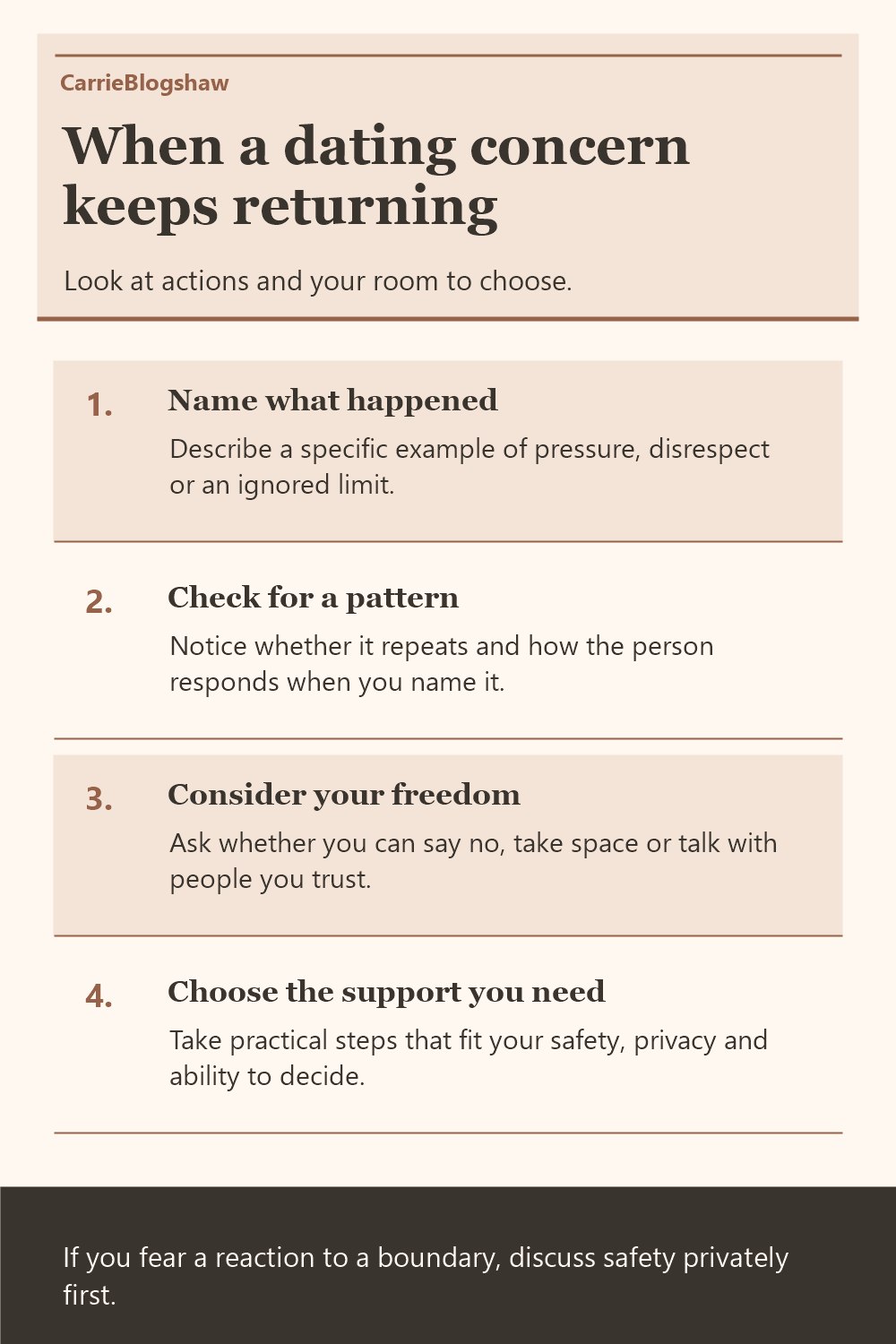
When a dating concern keeps returning
Look at actions and your room to choose.
- Name what happened Describe a specific example of pressure, disrespect or an ignored limit.
- Check for a pattern Notice whether it repeats and how the person responds when you name it.
- Consider your freedom Ask whether you can say no, take space or talk with people you trust.
- Choose the support you need Take practical steps that fit your safety, privacy and ability to decide.
If you fear a reaction to a boundary, discuss safety privately first.